
Every Saturday morning, Joshua Idowu, 37, picks up his soccer cleats and a whistle and leaves his home in Makoko, a century-old fishing community in Nigeria’s Lagos State that’s known as the “Venice of Africa.” For 45 minutes he treks across the floating settlement of wooden homes sitting on stilts above the polluted Lagos Lagoon until he reaches a sandy playing field, or “pitch,” opposite Makoko.
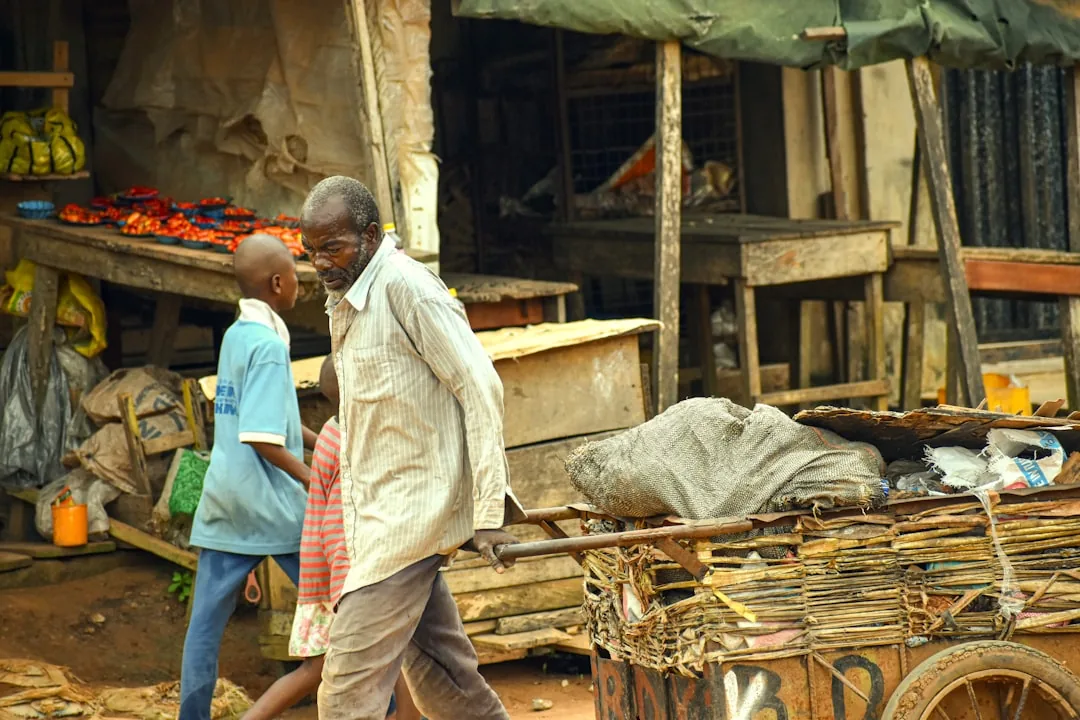
More than 60 boys ages 7 to 15 have already arrived by boat or through neighborhood boardwalks, ready to play. He leads them through gospel songs and prayers in the local Egun language before beginning soccer drills. “I also use this as an opportunity to teach them [Christian] morals,” Idowu said.
The children in Makoko attend overpopulated and underresourced makeshift schools, so when Idowu started teaching soccer in July 2024, he hoped it would provide a future for some of the boys living in the slum.
Then, beginning in December, the government demolished many of their homes. Idowu said he hasn’t seen some of the boys since.
“The children had to either relocate with their parents or [start working to help] support those who lost their businesses to the demolitions,” Idowu said. “Nobody is sure what’s next for them.”
With little notice and no plans for alternative housing, the Lagos State government displaced thousands of Makoko residents. It claimed the demolition was necessary for safety reasons and urban renewal.
Amphibious excavators knocked homes off their stilts and crushed the fragile wooden structures, collapsing them and sending household possessions into the lagoon. The state government demolished over 3,000 homes in Makoko, with the United Nations estimating the mass evictions displaced more than 40,000 people. Before the evictions, up to 300,000 people called the settlement home.
When residents in Makoko resisted the demolitions with protests, armed police accompanying the evacuation teams fired tear gas at them. Ten humanitarian organizations objected that “armed thugs, security personnel and demolition teams … set [homes] on fire with little or no notice, in some cases while residents were still [inside].”
The Lagos State House of Assembly halted efforts in February due to the backlash.
In Nigeria and throughout Africa, country leaders view urban-renewal projects as an opportunity to increase land value, improve the environment, revitalize decaying neighborhoods, and keep up with Africa’s booming population. But poor planning and execution can result in mass evictions that leave families homeless and desperate.
The Lagos State government defended the Makoko operation, as Governor Babajide Sanwo-Olu had said his administration set aside $2 million in 2021 to redevelop the Makoko waterfront to meet international standards, and assured residents the government would compensate them.
Idowu said residents have lost trust in the Lagos State government and doubt they will receive any compensation.
Nelson Ekujumi, who convened a press conference for Nigerian advocacy group Coalition for Good Governance, called the demolitions necessary because slums expose residents to floods, fires, and hazards caused by proximity to high voltage power lines: “From a regulatory standpoint, [the government’s] concerns are valid … and something ought to be done to correct the observed anomalies.”
Others disagree. Marcel Mbamalu, a Lagos-based researcher, argued the state’s government has a history of sacrificing the poor and ignoring human dignity during demolitions: “This history reveals a systemic pattern: communities are repeatedly cleared with minimal warning, scant compensation, and little workable relocation strategy.”
Andrew Samuel, whose house in Makoko was razed last December, told CT he couldn’t recover his properties—electronics, clothes, and furniture. He said the government had promised to demolish houses only within 50 to 100 meters from the neighborhood’s power line, but the amphibious excavator went farther.
“They didn’t even give me time to collect anything from my house,” Samuel said. “I watched them scatter everything I owned. Now I can’t even recognize where my house was built.”
One resident reported the government had demolished both her home and her church, of which her husband is the pastor.
Many residents sell fresh and dried seafood caught from the lagoon, earning $3 daily. Unable to afford alternative housing since the demolition, some are now living in canoes and in makeshift shelters.
Makoko is one of the more than 169 slums in Lagos that house about 60 percent of the state’s 17 million people, according to a 2025 State of Lagos Housing Market report. The government has targeted many of these slums for sporadic mass evictions and demolitions in the past few decades, including the rundown waterfront areas of the Ikota River corridor, the Lekki Axis, Oko-Baba Sawmill, Mile 2, and Third Mainland Bridge.
Though residents live in these shantytowns legally, they may have only informal claims to their homes, and Nigeria’s Land Use Act of 1978 allows the government to seize land for public use. This leaves people who live there with little protection.
During one mass eviction over a decade ago, the government gave Makoko residents only 72 hours to vacate their properties. Men later hacked down homes with machetes and power saws, leaving around 3,000 people homeless. Many sought shelter in boats or churches.
This year, residents of Makoko, Sogunro, and Oko-Agbon likewise received short evacuation notices before amphibious excavators demolished their homes.
Mass evictions across Africa follow similar patterns of forced removal. In 2025, Ethiopia’s government evicted thousands in Addis Ababa and other cities for a development project that included plans to build a palace. In 2023, security forces in Angola demolished more than 300 homes the government claimed residents had built illegally, which “jeopardiz[ed] the completion” of its development projects. In July 2018, a mass eviction in Nairobi, Kenya, left 10,000 slum residents without shelter, bringing down churches and health centers as well.
Olamide Ajayi, cofounder of The Slum Project, told CT that slum residents resist relocation even after demolition due to deep-rooted attachment: “You have those living in a particular place for over 35 years of their life. It’s going to take a lot of time and rewiring.”
For the past five years, The Slum Project has visited a different slum in Lagos every December, partnering with local churches to provide food, medicine, and scholarships to children. Volunteers also share the gospel with them, Ajayi said, “to ensure that we do not leave them the same way that we met them.”
But her organization doesn’t have the resources to help most displaced residents yet. “We do what we can,” Ajayi said. “Most of the [problems] are not within our control or theirs.”
In Makoko, Idowu is among the few Christians providing support to displaced residents. His church—Methodist Church Makoko, a Global Methodist congregation—shelters more than 40 people. Every night, men, women, and children spread their mosquito nets over woven mats, thin foam mattresses, or blankets laid on the bare concrete floor.
“It is quite unbearable,” he said. Food supplies are dwindling, and finding sanitary toilets, showers, and kitchens is difficult, Idowu said. Families also grapple with trauma after losing everything in a day. Idowu said displaced children may have to halt their education: “[Food and shelter are] what the parents will focus on now.”
Idowu worries he won’t be able to continue mentoring the missing boys from his soccer clinic. “They don’t have phones,” he told CT. “And I don’t know where they were relocated to.”
">Christianity Today.


Comments