
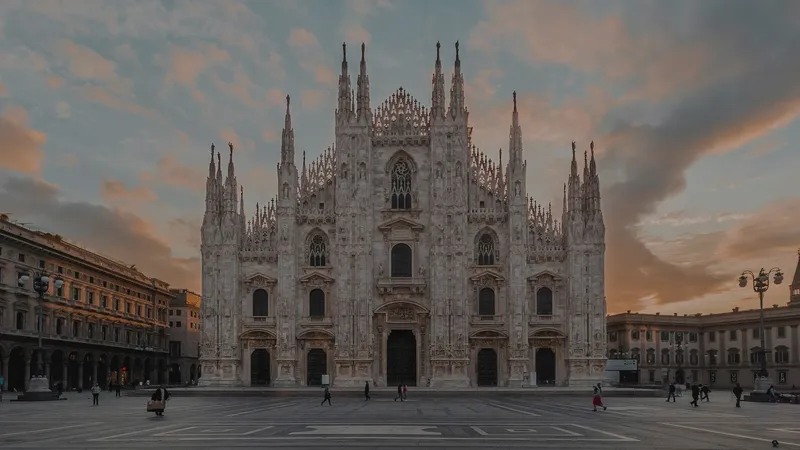
In the shadow of Milan's magnificent Duomo—a cathedral that took six centuries to build and can hold 40,000 worshippers—stands a humble former computer store that has become something extraordinary. While the ancient cathedral draws tourists and pilgrims from around the world, this small converted space in northwest Milan quietly hosts a different kind of gathering each Sunday morning: a simple worship service where hearts encounter the Gospel of Jesus Christ, often for the very first time.
The story of Chiesa Riformata Filadelfia represents one of the most beautiful transformations imaginable—a place once devoted to the latest technology now serves as an outpost for eternal truth. Under the pastoral care of Michael Brown, a missionary who leads Mission to Milan, this former computer store has become a beacon of hope in a city famous for its historic churches but desperately in need of living faith.
A Missionary Heart for Milan
Michael Brown's journey to Milan began not with a dramatic calling but with a series of short-term mission trips that gradually kindled an unquenchable passion for the Italian people. After serving as a pastor in California, Brown found himself drawn repeatedly back to Italy, each visit deepening his understanding of the spiritual hunger that exists beneath Milan's sophisticated exterior.
In 2018, Brown moved to Milan with his family, carrying a vision that seemed almost impossible: establishing a gospel-centered church in a city where religious tradition often overshadows personal relationship with Jesus Christ. Milan, despite its abundance of historic churches and religious art, presented unique challenges for evangelical ministry—cultural Catholicism mixed with secular materialism, creating a spiritual landscape both familiar with religious language and resistant to its transforming power.
The choice of a former computer store as the church's home carries profound symbolism. In a city celebrated for design and innovation, where fashion and technology reign supreme, the Gospel found its dwelling place in a space once dedicated to the very modern pursuits that often distract hearts from eternal matters. The transformation speaks to God's ability to redeem and repurpose anything for His glory—even our most contemporary cultural symbols.
"In Milan, a city of endless beauty and ancient faith traditions, the most profound need is not for more religious monuments but for personal encounters with the living Christ."
The Challenge of Cultural Christianity
Milan presents a particular challenge for gospel ministry that many American Christians might not immediately understand. The city is filled with magnificent churches—architectural wonders that speak to centuries of Christian heritage and artistic devotion. Yet as Brown discovered, the presence of religious buildings does not automatically translate to vibrant personal faith.
Many Milanese have been shaped by what sociologists call "cultural Christianity"—a familiarity with Christian symbols, stories, and traditions that exists alongside a practical atheism in daily life. People may attend Christmas midnight Mass or Easter services, appreciate religious art, and even maintain respectful attitudes toward the Church, while never experiencing the transforming power of the Gospel in their personal lives.
This cultural context makes Brown's work both more challenging and more necessary. He cannot assume biblical literacy among his listeners, nor can he take for granted that religious vocabulary carries the same meaning for his Italian audience that it does for American evangelicals. Each sermon becomes an exercise in cultural translation, presenting ancient truths in ways that penetrate modern hearts.
The former computer store setting actually serves this mission well. By meeting in a clearly non-traditional religious space, Chiesa Riformata Filadelfia removes some of the cultural barriers that might prevent seeking individuals from attending. People who might feel intimidated by entering a formal church building find themselves more comfortable in a space that feels contemporary and accessible.
Simple Worship, Profound Impact
The worship services at Chiesa Riformata Filadelfia embody a beautiful simplicity that stands in striking contrast to the elaborate liturgies available in Milan's historic churches. There are no ornate altars, no centuries-old frescoes, no gilded decorations—just believers gathering to hear God's Word preached with clarity and to respond in heartfelt worship.
This simplicity serves a crucial purpose in the Italian context. Many Milanese have associated Christianity with ritual complexity, institutional hierarchy, and cultural obligation rather than personal relationship. The stripped-down approach of evangelical worship helps newcomers focus on essential Gospel truths without being distracted by unfamiliar liturgical elements.
Brown's preaching emphasizes the core of Christian faith: humanity's need for salvation, God's provision through Christ's sacrifice, and the call to respond in repentance and faith. For many attending Chiesa Riformata Filadelfia, these concepts represent revolutionary ideas despite their lifetime of exposure to Christian culture. The former computer store becomes a place where religious familiarity gives way to spiritual transformation.
The intimate setting also fosters community in ways that larger, more traditional churches might struggle to achieve. When relatively few people gather in a modest space, everyone can be known, cared for, and discipled personally. This relational approach to ministry proves especially effective in Italian culture, where personal connections carry enormous importance.
The Gospel in the Fashion Capital
Milan's identity as a global fashion and design capital creates both opportunities and challenges for gospel ministry. The city attracts creative, ambitious, internationally-minded people who appreciate innovation and excellence—qualities that can be channeled toward spiritual growth when properly directed. Yet the same cultural emphasis on appearance, success, and material achievement can create barriers to embracing the Gospel's call to humility and dependence on God.
Brown and his congregation have learned to engage thoughtfully with Milanese culture rather than simply opposing it. They recognize that God can use the city's appreciation for beauty, craftsmanship, and creativity as bridges toward understanding divine truth. The Gospel doesn't destroy culture but redeems and transforms it, helping people see their talents and interests as gifts from God to be stewarded for His glory.
The former computer store setting speaks to this cultural engagement. Rather than retreating from modernity into purely traditional forms, Chiesa Riformata Filadelfia demonstrates that the Gospel can inhabit contemporary spaces and speak to contemporary concerns while maintaining its ancient power to transform lives.
"The beauty of Milan's fashion and design culture points toward the ultimate beauty found in Christ. Our calling is to help people see this connection and respond with worship."
Building Bridges Across Differences
One of the most significant aspects of Brown's ministry in Milan involves building relationships across cultural, linguistic, and religious differences. As an American pastor serving in Italy, he constantly navigates questions of cultural sensitivity while remaining faithful to biblical truth. This requires wisdom, humility, and deep love for the Italian people he serves.
The mission involves learning not just Italian language but Italian heart—understanding how Milanese people think, what they value, what concerns them, and how they process new ideas. This cultural fluency enables more effective gospel communication and demonstrates genuine care for the people being served rather than cultural imperialism disguised as ministry.
The former computer store becomes a neutral ground where people from different backgrounds can encounter each other and encounter God. International expatriates, Italian nationals, and curious visitors find common ground in their shared humanity and shared need for grace. The Gospel creates community across all the boundaries that typically divide urban populations.
Fruit That Remains
The most encouraging aspect of Chiesa Riformata Filadelfia's ministry lies in the transformed lives emerging from this unlikely setting. People who had never understood the Gospel despite lifelong exposure to religious tradition find themselves experiencing genuine conversion. Families discover new foundations for their relationships. Young adults find purpose and direction rooted in something deeper than career advancement or material success.
These transformations validate Brown's conviction that Milan desperately needs to hear the Gospel preached with clarity. The city's religious heritage, while beautiful and culturally significant, had not provided many residents with personal knowledge of salvation through faith in Jesus Christ. The simple services in the former computer store fill a gap that centuries-old cathedrals could not address.
Each Sunday, as this small congregation gathers in their converted commercial space, they demonstrate a profound truth: the Gospel's power to transform lives remains unchanged regardless of the setting in which it is proclaimed. Whether in a first-century house church or a twenty-first-century former computer store, the Word of God continues to accomplish its purposes in the hearts of those who hear and believe.
A Model for Modern Mission
The story of Chiesa Riformata Filadelfia offers encouragement to Christian workers serving in culturally challenging contexts around the world. It demonstrates that effective ministry often requires creative approaches, cultural sensitivity, and willingness to work outside traditional religious structures when necessary.
The former computer store setting reminds us that God can use any space for His purposes. We need not wait for ideal circumstances or perfect facilities to begin sharing the Gospel. Sometimes the most effective ministry happens in the most unlikely places, precisely because those settings remove barriers that prevent people from encountering Jesus.
As we consider the ongoing needs of urban European evangelism, Milano's example points toward strategies that might prove effective in other secular, post-Christian contexts. The combination of theological faithfulness, cultural engagement, relational ministry, and innovative thinking provides a model worth studying and adapting.
In a world increasingly divided between technological advancement and spiritual hunger, between global sophistication and personal emptiness, the former computer store in Milan stands as a beacon of hope. It reminds us that the ancient Gospel remains the answer to modern questions, that simple worship can produce profound transformation, and that God's love can inhabit any space offered to Him in faith.


Comentarios