
It's a question that has intrigued Catholics for centuries: can the Mass be celebrated outside of a church building? Whether prompted by missionary situations, natural disasters, military chaplaincy, or simple curiosity, this question touches on fundamental aspects of Catholic theology and liturgical law. The answer, perhaps surprisingly, is yes—but with important conditions.
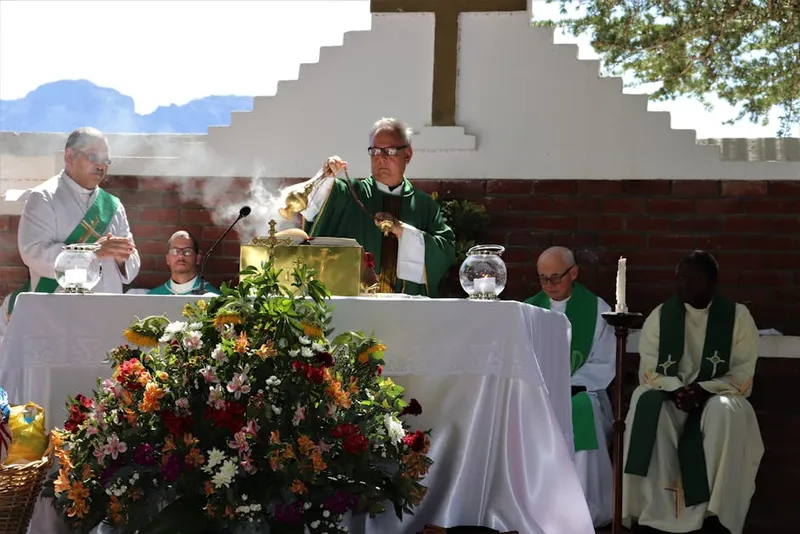
The Biblical Foundation
From the very beginning, Christian worship was not confined to temples or dedicated buildings. The Last Supper—the institution of the Eucharist—took place in "a large room upstairs, furnished and ready" (Mark 14:15), not in the Temple or a synagogue. The early Christians "broke bread in their homes and ate together with glad and sincere hearts" (Acts 2:46).
For the first three centuries of Christianity, there were no church buildings at all. Believers gathered in homes, catacombs, and even open fields. The sacred was not tied to a location—it was carried in the hearts of the faithful and made present wherever they gathered in Christ's name.
What Canon Law Says
The Code of Canon Law (Canon 932) states that the Eucharist is to be celebrated "in a sacred place" unless necessity requires otherwise, and in such cases, it should be celebrated "in a decent place." This language is intentionally flexible, recognizing that pastoral situations sometimes require creative solutions.
A "sacred place" typically means a church or chapel that has been properly dedicated or blessed. But "a decent place" can encompass a wide range of settings—a hospital room, a prison cell, a military camp, a home, or even an outdoor setting—provided the dignity of the celebration is maintained.
Historical Precedents
Throughout history, Mass has been celebrated in extraordinary locations:
Battlefield Masses: Military chaplains have celebrated Mass on makeshift altars in war zones, bringing the Eucharist to soldiers who might face death within hours. During World War II, priests celebrated Mass on the hoods of jeeps and on overturned crates.
Underground Masses: During times of persecution—from the Roman catacombs to Communist Eastern Europe to present-day China—the faithful have gathered secretly in basements, forests, and hidden rooms to celebrate the Eucharist.
Missionary Masses: From the jungles of South America to the plains of Africa, missionaries have celebrated Mass under open skies, on fallen trees, and in simple huts. Saint Francis Xavier celebrated Mass on beaches in India and Japan.
The Essential Requirements
While the location can vary, certain elements remain non-negotiable:
A validly ordained priest: Only a priest or bishop can celebrate Mass. "Do this in remembrance of me" (Luke 22:19)—this command was given to the apostles and, through them, to their successors.
Proper matter: Wheat bread and grape wine are required for valid celebration. No substitutions are permitted, as these elements were specifically chosen by Christ himself.
An altar or suitable surface: While a consecrated altar is ideal, any stable, dignified surface can serve as an altar when necessary. An altar stone or corporal (a square linen cloth) is traditionally placed on the surface.
Dignity and reverence: Whatever the setting, the celebration must be carried out with appropriate reverence. The Eucharist is the source and summit of Christian life (as the Second Vatican Council declared), and its celebration deserves the highest respect regardless of location.
Modern Applications
Today, Masses outside of churches occur regularly in various contexts: hospital and nursing home Masses for those who cannot travel, outdoor Masses for large gatherings like World Youth Day, prison Masses for incarcerated Catholics, and home Masses for the homebound.
During the COVID-19 pandemic, questions about location took on new urgency as churches closed and priests celebrated Mass in empty churches streamed online—a situation unprecedented in modern history.
The Deeper Truth
Ultimately, the question of where Mass can be celebrated points to a deeper truth: God is not contained by walls. As Solomon acknowledged at the dedication of the Temple: "But will God really dwell on earth? The heavens, even the highest heaven, cannot contain you. How much less this temple I have built!" (1 Kings 8:27).
Jesus promised: "For where two or three gather in my name, there am I with them" (Matthew 18:20). The Real Presence of Christ in the Eucharist is not dependent on stained glass windows or marble floors—it depends on the faith of the Church, the ministry of the priest, and the power of the Holy Spirit transforming bread and wine into the Body and Blood of Christ.
So yes, Mass can be celebrated outside a church building. And every time it is, it reminds us that the Church is not a building—it is the people of God, gathered by the Spirit, nourished by the Eucharist, and sent forth to transform the world.
Comentários