
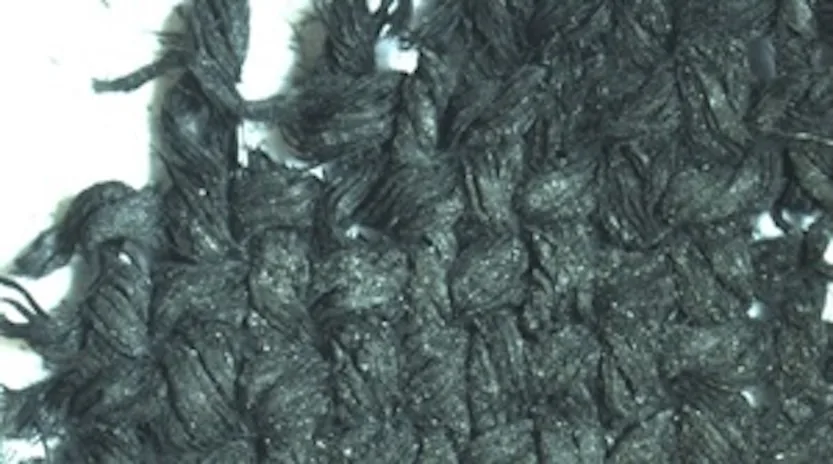
Microscope image of blue fabric (Tx1) found at Bronze Age Beycesultan in western Turkey. Courtesy Çiğdem Maner, Eşref Abay, Recep Karadağ, Emine Torgan Güzel, “Untwisting Beycesultan Höyük: The Earliest Evidence for Nålbinding and Indigo-dyed Textiles in Anatolia” Antiquity 99 (2024), CC BY 4.0.
Textiles play an important role in the world of the Bible. From the finely crafted garments described in the book of Exodus to the special robe given to Joseph in Genesis, clothing in biblical narratives often signals status and wealth. Yet actual textiles rarely survive in the archaeological record because they are made of organic fabrics that decay easily. Usually, scholars reconstruct ancient textile production indirectly through tools such as spindle whorls, loom weights, and textile impressions left on clay. A recent study of two burnt textile fragments discovered at Beycesultan in western Anatolia (Turkey) offers a rare glimpse into textile production during the Middle and Late Bronze Ages (roughly 2000–1200 BCE)—eras often associated with the patriarchal period of the Bible.
FREE ebook: Israel: An Archaeological Journey. Sift through the storied history of ancient Israel.
First Name:* Last Name:* Email Address: * * Indicates a required field. SUBMIT If you don’t want to receive the Bible History Daily newsletter, uncheck this box.
Beycesultan is a large settlement mound that was occupied for thousands of years. Excavations first conducted in the 1950s uncovered numerous occupation layers dating from the late Chalcolithic period through the end of the Bronze Age. Among the most notable discoveries was a large palace complex destroyed by fire. Renewed excavations beginning in 2007 have continued to reveal evidence that the settlement was an important regional center during the Bronze Age. The textile fragments discovered there were found adhered to the ground within the burned remains. The charring stabilized the fabric and prevented it from decomposing entirely.
The two textile fragments analyzed in the study were discovered in different contexts within the settlement. The first fragment (Tx1) was found in a Middle Bronze Age structure dating to approximately 1915 to 1745 BCE. Nearby, archaeologists discovered pottery vessels, storage jars, and a stone weight, as well as four systematically spaced postholes likely used for a loom frame. The second fragment (Tx2) was uncovered in a later domestic structure dating to roughly 1700 to 1595 BCE. This room contained numerous textile tools including spindle whorls, loom weights, a weaving comb, bronze needles, and beads. The concentration of tools strongly suggests that this space was regularly used for textile production.
To understand how the fabrics were made, researchers used several scientific techniques. Optical microscopy allowed them to study the structure of the threads, while scanning electron microscopy helped identify the fibers themselves. The team also used high-performance liquid chromatography to detect any dyes that may have been applied to the cloth.
The first fragment (Tx1) produced the most surprising results in terms of weave, material, and color. Microscopic analysis showed that the fabric lacked the typical structure found in woven cloth. The threads formed loops created by passing a single needle through earlier stitches, indicating that the textile was made using the technique known as Nålbinding or “single-needle” knitting. This looping method predates modern knitting and creates a dense, durable fabric. If this interpretation is correct, the fragment may represent the earliest physical example of this technique discovered in Anatolia and possibly the broader Near East. Further analysis revealed that the yarn was made from hemp fibers, a material rarely identified in Bronze Age textiles from this area. Chemical testing revealed another remarkable feature: the cloth had been dyed blue. Researchers detected indigotin, a compound likely derived from the plant Isatis tinctoria (woad), making this the earliest known example of blue-dyed fabric from a Bronze Age context in Anatolia.
Microscope image of Tx1 (cropped), evincing the Nålbinding or “single-needle” looping technique. Courtesy Çiğdem Maner, Eşref Abay, Recep Karadağ, Emine Torgan Güzel, “Untwisting Beycesultan Höyük: The Earliest Evidence for Nålbinding and Indigo-dyed Textiles in Anatolia” Antiquity99 (2024), CC BY 4.0.
Finds from the second fragment (Tx2) were simpler but still informative. Microscopic analysis showed that it featured the most basic weaving pattern, tabby weave. The fibers were likely plant-based, though heavy burning made precise identification difficult. Chemical analysis detected no dye, suggesting that the cloth was probably intended to show its natural color.
Together, these finds reveal that the inhabitants of Beycesultan produced a range of fabrics using different techniques, fibers, and levels of craftsmanship. Such discoveries help scholars reconstruct the economic and technological landscape of the ancient Near East. For readers of the Bible, they provide valuable context for the many references to clothing, weaving, and dyed fabrics—reminding us that behind the biblical texts stood a vibrant world of skilled artisans. Blue textiles are of particular significance: Israelite priests wore blue threads in their garments (Exodus 28:31–35), the broader Israelite community was instructed to use blue cords to attach tassels to the corners of their cloaks (Numbers 15:38–39), and the tabernacle curtains featured blue alongside purple and scarlet (Exodus 26:1). The blue-dyed fabric from Beycesultan offers a tangible example of how such prized colors could be produced, helping us better imagine the luxurious, symbolically charged textiles that colored the biblical world.
Lauren K. McCormick is an assistant editor at Biblical Archaeology Review and a specialist in ancient Near Eastern religions, visual culture, and the Bible. She holds degrees in religion from Syracuse University, Duke University, New York University, and Rutgers University, and completed a postdoctoral fellowship on religion and the public conversation at Princeton University.
Become a BAS All-Access Member Now! Read Biblical Archaeology Review online, explore 50 years of BAR, watch videos, attend talks, and more
Related reading in Bible History Daily The Royal Purple of David and Solomon
Ancient Fabric Dyed Biblical Blue?
What Color Was Tekhelet?
Ancient Israel’s Tyrian Purple Factory
All-Access members, in the BAS Library The Search for Biblical Blue
Not a BAS Library or All-Access Member yet? Join today.

Comentários