
Digital reconstruction of the Ein Gedi synagogue. Image courtesy Roy Albag.
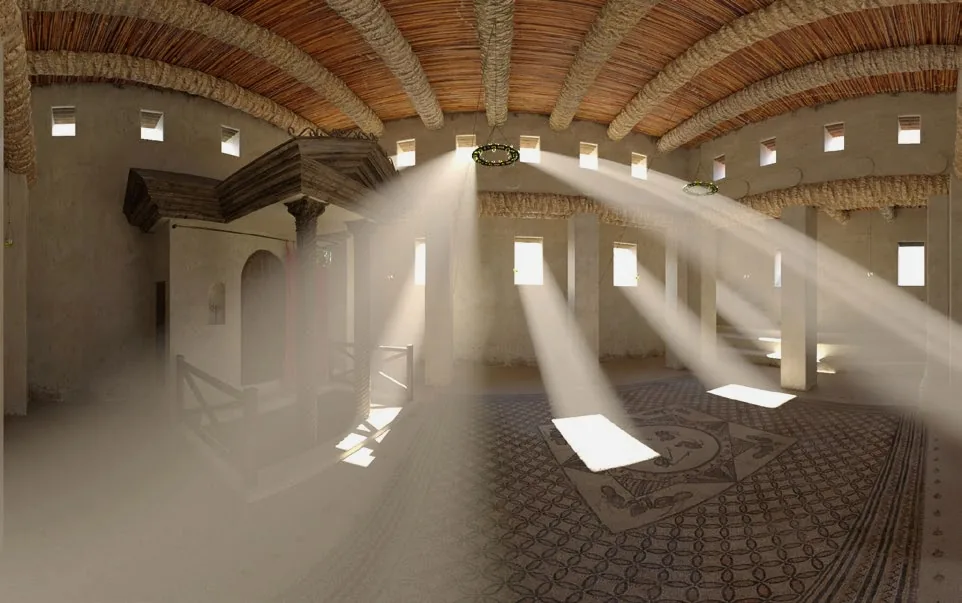
What were early synagogues like?
Traditional scholarship has answered this simple question with studies of the built structures, analyzing their architecture and examining evidence of construction, rebuilding, and destruction. With the help of written sources, scholars have also gained a solid understanding of how these religious buildings functioned within their communities. Only in recent years, however, has attention turned to exploring also how these sacred spaces felt.
In late antiquity (fourth–seventh centuries), following the Roman destruction of Jerusalem and the Temple in 70 CE, synagogues became vitally important centers of social and religious life for Jewish communities across the larger Mediterranean world. In the new environment, synagogues were not only places of worship but also centers of community life and learning. But although their architecture and decoration, brought to life through numerous excavations around the Mediterranean basin, provide a rich picture of their splendor, it is the smaller implements and objects of daily use that can answer how these holy spaces felt on a more personal level.
Menorah from Hammath Tiberias. Photo courtesy Photo Companion to the Bible.
Writing for the Spring 2026 issue of Biblical Archaeology Review, Karen B. Stern asks, “But how did synagogues look and feel to their ancient visitors? How did Jews illuminate their synagogues, when they congregated in the darkness of early mornings and late evenings? What were synagogue acoustics like? What did synagogues smell like?” A professor of Classics at Brooklyn College, City University of New York, Stern explores in her teaching and research the material culture of Jews in the broader Mediterranean during the Roman and late antique periods.
“Sensing the Synagogue” BAS Scholars Series with Karen B. Stern, CUNY, Brooklyn College Monday, March 9, 2026
Sensing the Synagogue explores how light, sound, smell, touch, and space shaped everyday worship and spiritual experience in ancient Jewish synagogues across the Mediterranean world.
Learn More
Focusing on what archaeology and written sources can tell us about the use of lighting and incense, her BAR article explores how ancient people experienced synagogues through their senses of sight and smell. To address these questions, Stern turns to smaller artifacts from ancient synagogues that were used for lighting and burning of incense or other aromatics. These include various types of lamps, incense burners, and ritual shovels.
A Roman-period incense shovel, made of bronze around 100 CE. Photo: Public domain / The Metropolitan Museum of Art, Purchase, 1900.
Lamps in antiquity took different forms. Eminent in Jewish and Samaritan contexts was the menorah, a free-standing candelabrum. “Fragments of such menorot survive from fourth- and fifth-century synagogues discovered in both Roman and Byzantine Palestine and the broader Mediterranean world,” writes Stern. “One well-preserved stone menorah from Hammath Tiberias (see second image above) has branches carved with relief decorations, possibly etched beads, calyxes, or pomegranates. Several small depressions on top of the stone were likely fitted with cups containing oil and wicks for lighting.” Other types included chandeliers featuring glass bowls inserted into metal frames. The most common and affordable, however, were small oil lamps—either ceramic ones (made on potter’s wheel or from a mold) or cast in bronze.
“Much like illumination, the role of scent in ancient Jewish devotional practices, let alone the use of incense or aromatics inside ancient synagogues, has rarely been considered,” writes Stern, introducing another aspect of how late antique synagogues were experienced. Scholars have assumed that the ancient practice of offering incense sacrifice stopped with the destruction of the Temple. Written sources and archaeological finds from across the Mediterranean, however, suggest that at least some Jewish communities continued to use incense and other aromatics as part of their religious practice. Among the prime pieces of evidence is this incense burner now in the Brooklyn Museum. A dedicatory inscription etched on the bowl just below the ornamental rim indicates the censer was donated by one Auxanon, who must have been a wealthy member of a Jewish or Samaritan community. Another group of telling objects are incense shovels, including the example pictured above, now in the Metropolitan Museum of Art.
“These aggregated sights, smells, and tastes thus not only shaped visitors’ feelings of holiness, but also helped constitute the experience of the sacred on a practical and sensory level,” writes Stern in conclusion. “Inside ancient synagogues, where prayer was an activity of the body as well as the mind, illumination and scent functioned synergistically to blur the mundane and the holy, the functional and the devotional, and the past and the present.”
To further explore how early Jews experienced ancient synagogues, read Karen B. Stern’s article “Sensing the Synagogue,” published in the Spring 2026 issue of Biblical Archaeology Review.
Subscribers: Read the full article “Sensing the Synagogue” by Karen B. Stern in the Spring 2026 issue of Biblical Archaeology Review.
Not a BAS Library or All-Access Member yet? Join today.
Related reading in Bible History Daily An Ancient Jewish Lamp Workshop in the Galilee
Jewish Worship, Pagan Symbols
Ancient Synagogues in Israel and the Diaspora
Jesus and Synagogues
All-Access members, in the BAS Library Synagogues: Before and After the Roman Destruction of the Temple
Did the Synagogue Replace the Temple?
Jesus in the Synagogue
Not a BAS Library or All-Access Member yet? Join today.

Comments