
Ptolemaic period mummified individual. Courtesy Paul Hudson from United Kingdom, CC-BY 2.0 https://creativecommons.org/licenses/by/2.0, via Wikimedia Commons.
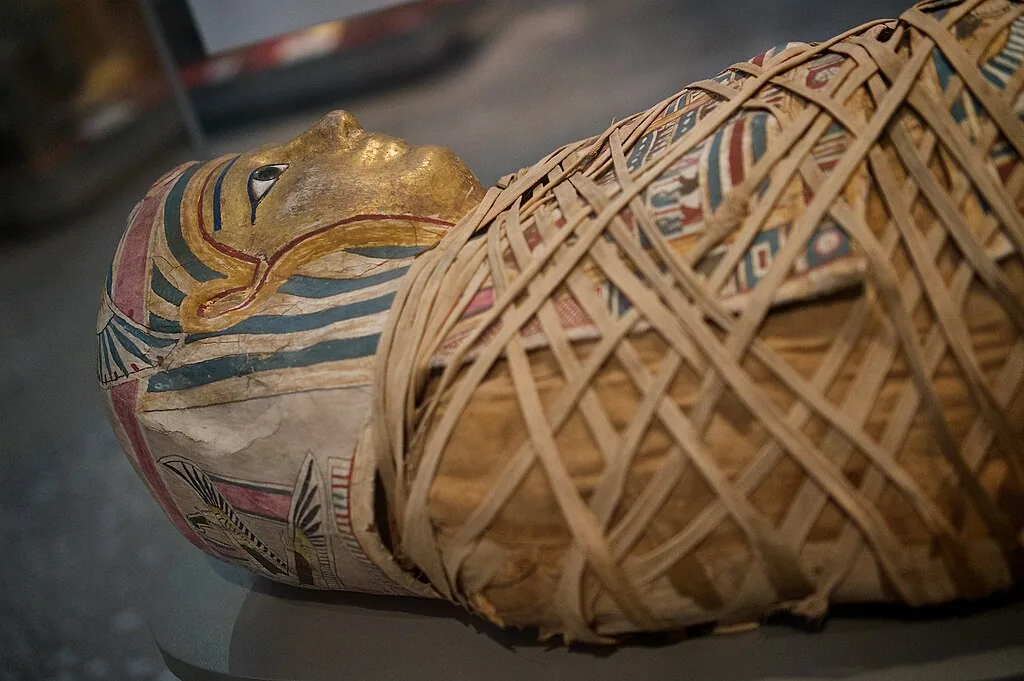
Few things captivate the imagination like Egyptian mummies. Their intricate wrappings and lifelike preservation carry both religious significance and enduring mystery. A recent study focuses on something far more earthly: their smell.
Mummified remains have a distinctive musty and woody aroma, which has been shown to preserve a chemical record of ancient embalming practices. The study is showing how scientists can read that record without harming the priceless burials. Even the faintest scents from mummified remains carry a wealth of historical information, offering new ways to connect with Egypt’s ancient past without unwrapping a single bandage.
Mummification in ancient Egypt was not just a burial practice but a spiritual one. Preserving the body ensured safe passage into the afterlife. Over thousands of years, Egyptians experimented with natural materials that slow decay, including animal fats, plant oils, beeswax, resins, and, later, bitumen. Each material leaves a chemical “fingerprint,” releasing tiny molecules into the air called volatile organic compounds.
The study’s innovation lies in analyzing these compounds non-invasively. Scientists capture them on fiber waved in the air around the mummified remains. The compounds stick to the fiber and are then analyzed to identify which embalming materials were used. Instead of cutting into the remains, researchers “sniff” it chemically. The researchers report that short-chain fatty acids reveal oils, mono-carboxylic fatty acids and cinnamic compounds indicate beeswax, sesquiterpenoids point to resins, and naphthenic compounds signal bitumen.
This approach even distinguishes differences between mummified individuals from different historical periods, showing how embalming materials age over time. Some compounds degrade quickly; others persist for millennia. Understanding these patterns helps explain why two mummified individuals may smell different despite similar treatments. It also illuminates the evolution of Egyptian embalming, from simple fats and oils to complex mixtures including costly resins and bitumen.
Easter: Exploring the Resurrection of Jesus
In this free eBook, expert Bible scholars offer in-depth reflections on the resurrection.
Email(Required) REQUEST FREE BOOK
DOWNLOAD EBOOK
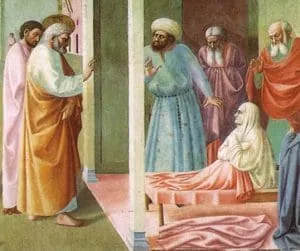
The study has relevance for biblical archaeology as well. Ancient Israelite custom held that corpses be washed, anointed with oils and spices, and wrapped—a process also reflected in New Testament accounts of Jesus and Lazarus. After Jesus’s crucifixion, for example, his body was washed, anointed with myrrh and aloes, and wrapped in linen before being laid in a tomb (John 19:39–40). While Israelite and early Christian practices did not involve chemical embalming, the careful washing, anointing, and wrapping reflects a similar spiritual care: honoring the deceased, masking decay, and preparing the body for what comes next.
Lauren K. McCormick is an assistant editor at Biblical Archaeology Review and a specialist in ancient Near Eastern religions, visual culture, and the Bible. She holds degrees in religion from Syracuse University, Duke University, New York University, and Rutgers University, and completed a postdoctoral fellowship on religion and the public conversation at Princeton University.
Become a BAS All-Access Member Now! Read Biblical Archaeology Review online, explore 50 years of BAR, watch videos, attend talks, and more
Related reading in Bible History Daily Unwrapping Mummy Mysteries
Pharaoh’s Mummy Reveals Murder, Palace Intrigue
Two Burials of Jesus of Nazareth and the Talpiot Yeshua Tomb
All-Access members, in the BAS Library BAR Jr.: Gamma Rays Halt Deterioration of Mummy of Ramesses II
The Raising of Lazarus
Not a BAS Library or All-Access Member yet? Join today.
Kommentare